
Rock & Boulder Walls
Placed by machine, battered back into the bank, and free draining by nature rather than by detail.
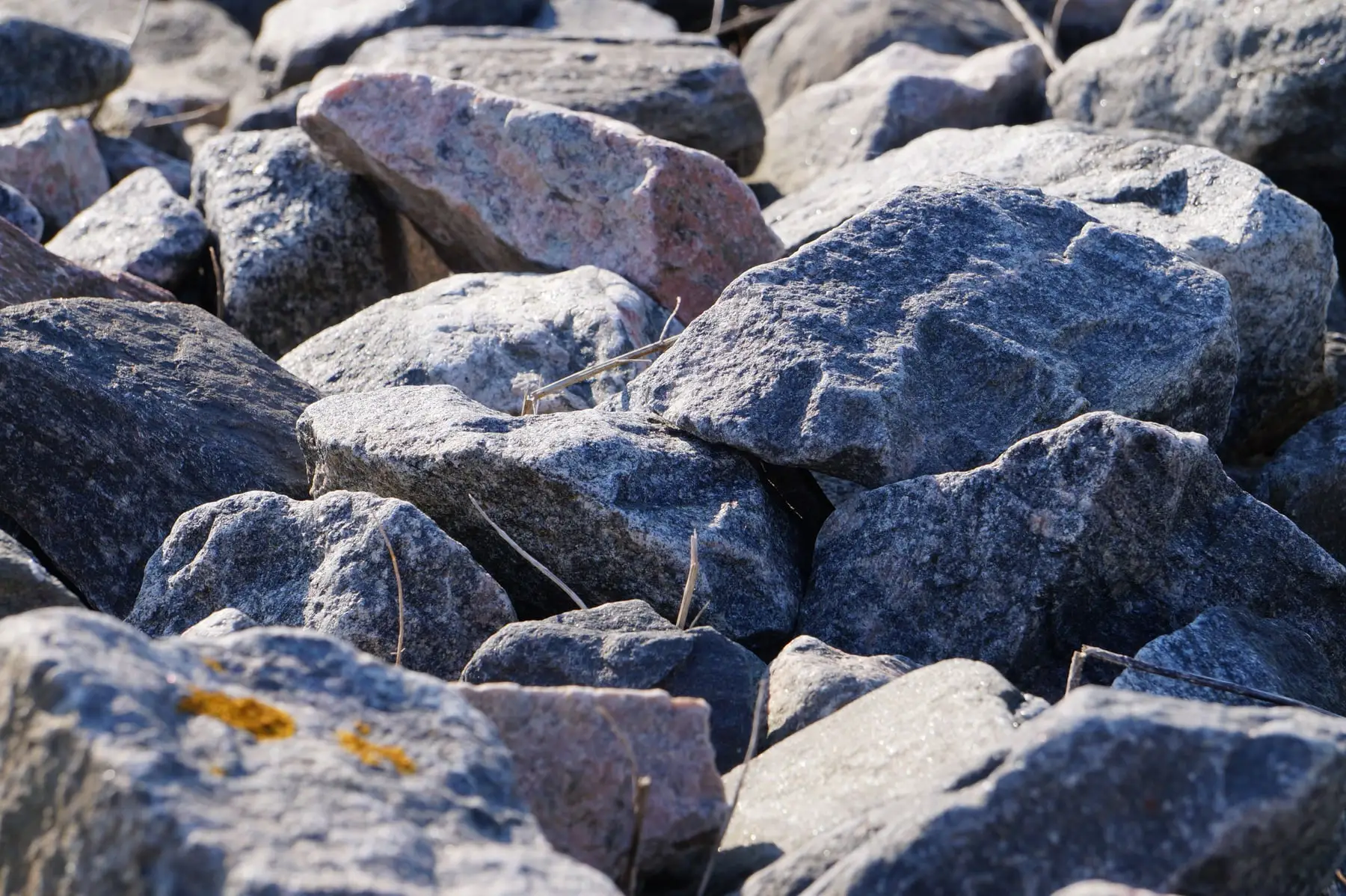
- Free draining through the wall, so pressure never builds
- Suits long informal banks where a straight wall would look wrong
- Battered back into the slope rather than standing vertical
- Rock sized to the height instead of to what was on the truck
A rock wall is large stone placed by excavator on a prepared base, stacked and keyed together and battered back into the slope it is holding. It is a different structural idea to a sleeper or block wall: rather than a thin element resisting soil pressure, it is a heavy mass leaning into the bank.
The one big advantage
A rock wall drains through itself. The voids between the stones are a continuous path for water, so the hydrostatic pressure that brings down solid walls in this climate simply never develops. In a place that takes the rainfall Cairns does, that is a real structural advantage rather than a nice extra.
It still gets a filter layer behind it. Water passing freely through the wall will carry soil fines with it unless something stops them, and a rock wall that has been quietly washing the bank out from behind will develop hollows and slump years later. The geotextile is what makes the free drainage a feature instead of a slow erosion problem.
Where it suits
Long informal banks, rural and semi-rural blocks, creek batters and anywhere the wall is going to be a visible landscape element rather than a hidden structural one. It reads as part of the ground in a way a straight manufactured wall does not, which matters on a large block or a bush setting.
It also handles irregular alignments without any of the setting-out constraints a sleeper wall has. The bank can wander and the wall follows it.
Where it does not
A rock wall needs footprint. The batter means the base sits well forward of the top, so a wall of any height occupies a substantial depth of ground. On a tight suburban block where the whole point is to win back usable flat area, that is exactly the wrong trade: you spend the space you were trying to create.
It also needs machine access. The stone is placed by excavator, and if a machine of the required size cannot physically reach the wall line, the wall cannot be built. That is worth establishing before anything else.
What actually decides quality
Rock size relative to wall height, and whether each stone is placed or tipped. A good wall has stone sized for the job, individually set so each one beds onto the ones below and keys against its neighbours, with the batter maintained consistently up the face. A poor one has whatever was on the truck, dropped roughly into line, with the gaps filled by smaller stone that works its way out over a few seasons.
The base preparation matters as much. A rock wall built straight onto soft or unprepared ground settles unevenly and the face goes out of line.
Call 0468 066 055 with the length of the bank and how much fall you are dealing with.
Price this work
Rough height, rough length, what sits above and below it, and how a machine would reach it. A photo taken from side on tells us more than one taken straight at the bank.
- On site
- Monday to Friday 6.30am to 4pm, Saturday mornings
- Covering
- The western foothills, the estate suburbs, the northern beaches and south to Gordonvale
- Quotes
- Measured on the block, given in writing, no obligation
- We stand on the block before anybody talks about a number, because a slope cannot be priced from a description
- The quote states the height, the material, the footing, the drainage and where the spoil goes
- If engineering or approval is needed it is priced in, not added once the machine is already on site