
Retaining Wall Repairs
Finding out why the wall is moving before anybody quotes, and saying plainly when a repair will not hold.
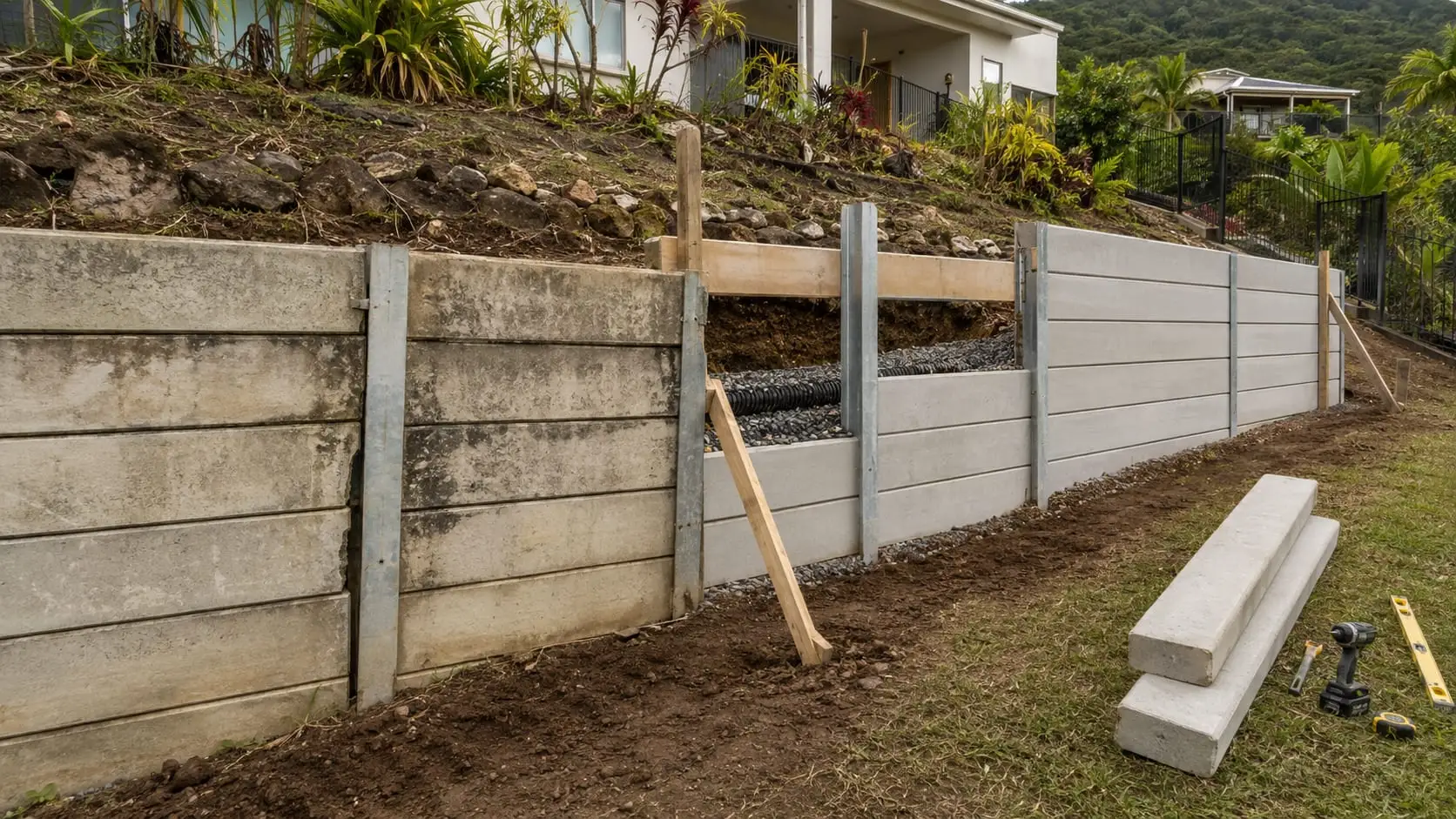
- Cause diagnosed before any repair is priced
- Drainage checked first, because it is usually the answer
- Straight verdict when a wall needs replacing rather than patching
- Urgency assessed honestly, including when there is none
A retaining wall that has started to move is telling you something, and the something is almost never that the wall was badly built above ground. Repairing it without establishing what changed produces a wall that fails again in the same way, usually within a couple of seasons.
The first job is finding out why
There are a small number of causes and they have very different fixes.
Water behind the wall with nowhere to go is the most common by a wide margin. Either the drainage was never installed, or the subsoil drain has silted up, or the outlet has been buried, blocked or built over. In every one of those cases the wall is now carrying a load it was never designed for and no amount of strengthening the face will address it.
Footings that were undersized for the load are the second. The signature is a wall rotating outward at the base while the wall itself stays straight, and it is common on walls where the height crept up during construction without the footing schedule changing.
Surcharge added after the wall was built is the third, and it catches people out. A wall designed for a garden bank behaves quite differently once a driveway, a shed, a pool or a parked vehicle sits behind it. The wall did not change, the load did.
Erosion undermining the base and, on timber walls, simple decay and termite damage account for most of the rest.
What the movement tells us
A wall leaning uniformly outward at the top usually means pressure behind it. A wall rotating at the base points at the footing. A bulge in the middle of a span with the ends still true means the sleepers or the blocks are spanning further than they can carry. Cracking in a stepped line up a block wall means insufficient reinforcement. Soil visibly washing through the face means the filter layer has failed or was never there.
Ground dropping or a lawn sinking behind an apparently sound wall means material is leaving through the wall, which is a problem even though nothing looks wrong from the front.
When we will tell you to replace it
Repairing a wall is worth doing when the structure is sound and the cause is fixable, and drainage retrofits are genuinely the most common repair we carry out because they address the actual problem without rebuilding anything.
Where a wall has moved substantially, where the footings are inadequate for the load it now carries, or where a timber wall has decayed through its posts, a repair is money spent on something that is going to keep moving. You will be told that plainly, along with an honest assessment of how urgent it is, because a wall that has been leaning at the same angle for a decade is a different conversation from one that moved last month.
If yours is moving, read the signs a retaining wall is failing or call 0468 066 055 and describe what you are seeing.
Questions about retaining wall repairs
Can my wall be repaired, or does it need replacing?
It depends on what is moving and why. A structurally sound wall that was built without drainage can very often be fixed by retrofitting drainage behind it, which is a much smaller job than a rebuild and addresses the actual cause. A wall that has rotated at the base on inadequate footings, or a timber wall whose posts have gone at ground line, is money spent on something that will keep moving. You will be told which one you have, along with how urgent it honestly is.
Price this work
Rough height, rough length, what sits above and below it, and how a machine would reach it. A photo taken from side on tells us more than one taken straight at the bank.
- On site
- Monday to Friday 6.30am to 4pm, Saturday mornings
- Covering
- The western foothills, the estate suburbs, the northern beaches and south to Gordonvale
- Quotes
- Measured on the block, given in writing, no obligation
- We stand on the block before anybody talks about a number, because a slope cannot be priced from a description
- The quote states the height, the material, the footing, the drainage and where the spoil goes
- If engineering or approval is needed it is priced in, not added once the machine is already on site